If your engine is overheating, it’s not just an inconvenience—it’s a warning sign that something in your cooling system is no longer doing its job.
At Chrome Auto Repair in Madison Heights, VA, we’ve been helping local drivers since 2020 diagnose overheating issues before they turn into major engine damage. As a family-owned shop led by Jeffrey Eddy with over 25 years of experience, our ASE-certified technicians focus on identifying the root cause—not just replacing parts.
If you’re experiencing Engine Overheating in Madison Heights, VA, understanding what’s happening under the hood can help you avoid costly repairs and know exactly when to stop driving.
Engine Overheating in Madison Heights, VA – What It Means When Your Temperature Gauge Rises
When your temperature gauge starts climbing, your engine is telling you something is wrong—but not all overheating situations happen the same way.
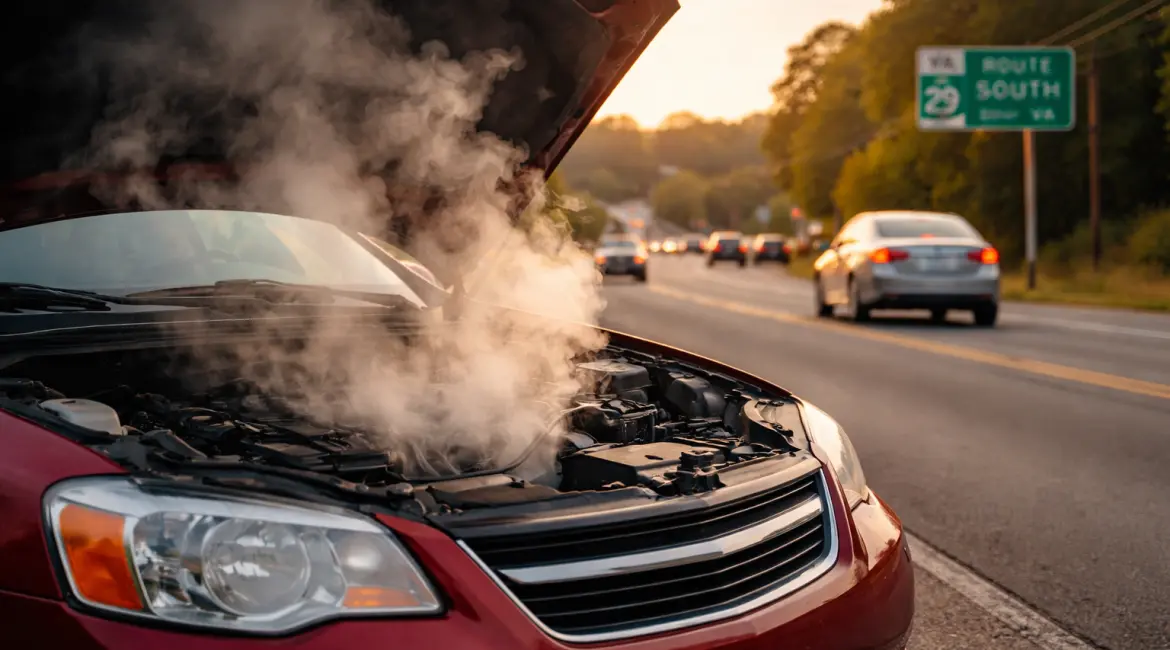
Last summer, a driver in Madison Heights was sitting in traffic near Route 29 when their temperature gauge crept above normal. At first, they kept driving, expecting it to stabilize. Within minutes, steam began coming from under the hood. The issue turned out to be a cooling fan that wasn’t activating at idle—something that only became a problem in traffic, not at highway speeds.
Engine overheating occurs when the cooling system cannot remove heat fast enough, allowing temperatures to exceed safe operating limits and damage internal components.
Most engines operate between 195–220°F, and cooling fans typically activate between 200–230°F depending on the vehicle. Once temperatures climb beyond that range, heat builds rapidly and unevenly.
In Madison Heights, stop-and-go traffic along S Amherst Hwy and Route 29 regularly exposes weak cooling systems—especially during hot summer months.
What to Do Immediately If Your Engine Overheats in Madison Heights
If your engine starts overheating, your next decision matters more than most people realize.
The safest approach is to reduce heat and stop driving as soon as possible. Turn off the air conditioning to reduce engine load, then turn the heat on full to help draw heat away from the engine. From there, pull over safely and shut the engine off.
One of the most common mistakes drivers make is trying to “make it a little further.” That extra mile is often what turns a minor issue into a blown head gasket.
Never open the radiator cap while the engine is hot—the system is pressurized (typically 13–16 PSI), and releasing that pressure can cause serious injury.
If you’re unsure what to do, this is when searching for overheating car repair near me becomes urgent.
Signs Your Engine Is Overheating
Overheating rarely starts with steam—it usually gives warning signs first.
You may notice the temperature gauge slowly rising above normal, especially during traffic or idling. In other cases, a sweet coolant smell may appear, or the engine may begin to lose power as temperatures increase.
As the condition worsens, steam may come from under the hood, and coolant may begin to boil inside the reservoir. These are signs the system is already struggling to maintain proper temperature.
Recognizing these early symptoms can prevent serious damage.
How the Cooling System Works – Why Your Engine Stays at the Right Temperature
Your engine generates a tremendous amount of heat every time it runs. Without a cooling system constantly removing that heat, temperatures would rise fast enough to cause damage within minutes.
The cooling system circulates coolant through the engine, where it absorbs heat, and then moves it through the radiator where that heat is released into the air.
This process depends on both coolant flow and airflow.
The water pump keeps coolant moving, while the thermostat regulates when that flow begins. The radiator transfers heat outward, and the cooling fan ensures airflow when the vehicle is not moving fast enough.
The system also operates under pressure, which raises the boiling point of coolant and allows it to function efficiently above 212°F.
If any part of this balance fails—flow, airflow, or pressure—the system can no longer control temperature effectively.
Top Causes of Engine Overheating in Madison Heights Vehicles
At Chrome Auto Repair in Madison Heights, VA, we see consistent patterns in overheating issues—especially during summer traffic.
In many cases, overheating begins with a small issue that gradually worsens. A slow coolant leak may not cause immediate problems but can lead to overheating under heavier conditions. A thermostat may begin sticking intermittently before failing completely. Water pumps can lose efficiency as internal impellers wear down.
Radiators can also become restricted over time due to internal buildup, reducing their ability to transfer heat effectively.
Cooling fan failures are especially common in Madison Heights because they often go unnoticed until the vehicle is sitting in traffic.
At Chrome Auto Repair in Madison Heights, VA, we diagnose these issues daily using a structured, test-first approach.
Why a Small Coolant Leak Can Lead to Major Engine Damage
A coolant leak does more than lower fluid levels—it disrupts the entire system.
When coolant drops, air enters the system. Unlike coolant, air does not transfer heat effectively, creating localized hot spots inside the engine.
At the same time, system pressure drops, lowering the boiling point and increasing the likelihood of overheating.
These conditions—air pockets, reduced pressure, and uneven heat—are what lead to warped cylinder heads and internal engine damage.
What starts as a small leak can escalate quickly if left unaddressed.
Why Your Car Overheats in Traffic but Not on the Highway
This pattern is one of the most important diagnostic clues.
If your vehicle overheats at idle but cools down while driving, the issue is typically airflow-related. The cooling fan may not be functioning properly, which prevents airflow through the radiator at low speeds.
If the vehicle overheats at highway speeds, the issue is more likely related to coolant flow—such as a restricted radiator or failing water pump.
Understanding whether overheating happens at idle, highway speed, or under load helps pinpoint the root cause quickly.
How to Diagnose Engine Overheating Problems
Diagnosing overheating correctly requires more than checking coolant levels—it requires understanding how the system behaves under different conditions.
Technicians typically begin by checking coolant levels and pressure. From there, they test for leaks, evaluate thermostat operation, and verify that the cooling fan activates at the correct temperature range.
Scan tools are often used to monitor live engine temperature data, while infrared thermometers help identify uneven heat distribution across the radiator and engine.
In more advanced cases, combustion gas testing is used to determine if a head gasket is allowing exhaust gases into the cooling system.
This step-by-step approach prevents unnecessary part replacement and ensures the real issue is identified.
What Happens Inside Your Engine When It Overheats
Overheating doesn’t just raise temperature—it begins a chain reaction of damage.
As heat increases, engine oil begins to lose its ability to lubricate. Metal components expand beyond their intended tolerances, and aluminum parts like cylinder heads can warp.
Once warping occurs, the head gasket may fail, allowing coolant and oil to mix. This leads to further internal damage, reduced engine performance, and significantly higher repair costs.
This process can happen faster than most drivers expect—especially if the vehicle continues to be driven while overheating.
Coolant Chemistry – Why Old Coolant Causes Overheating
Coolant is not just a fluid—it’s a chemical solution designed to manage heat and protect internal components.
Over time, coolant breaks down. Its pH balance changes, corrosion inhibitors wear out, and deposits begin forming inside the system.
These deposits restrict coolant flow and reduce the system’s ability to transfer heat effectively.
What many drivers don’t realize is that coolant can appear full and still be ineffective.
Using the wrong type of coolant—or mixing different formulas—can accelerate internal damage and lead to overheating.
How Madison Heights Driving Conditions Increase Overheating Risk
Driving conditions in Madison Heights put additional stress on cooling systems.
Stop-and-go traffic along Route 29 reduces airflow, while high summer temperatures increase engine heat load. Idling conditions and short trips further limit the system’s ability to stabilize temperature.
At Chrome Auto Repair in Madison Heights, VA, we consistently see more overheating issues during peak summer months—especially in vehicles that spend extended time in traffic.
Cooling System Diagnostics at Chrome Auto Repair in Madison Heights, VA
Overheating problems require accurate testing—not guesswork.
At Chrome Auto Repair in Madison Heights, VA, our ASE-certified technicians follow a structured diagnostic process that includes pressure testing, leak detection, thermostat evaluation, radiator flow testing, and cooling fan operation checks.
Advanced tools such as infrared temperature scanners and live data analysis allow us to identify issues that are not visible during basic inspections.
You can learn more about how these systems are handled through our approach to major engine and system diagnostics.
Can I Drive My Car If It’s Overheating?
This is one of the most common—and most important—questions drivers ask.
The short answer is no.
Even a short drive while overheating can cause serious engine damage. While it may be tempting to continue driving a short distance, doing so increases the risk of warping engine components or causing internal failure.
If the temperature gauge is rising rapidly or steam is present, the safest option is to stop driving immediately.
How Much Does Overheating Repair Cost in Madison Heights, VA?
Repair costs vary depending on how early the issue is diagnosed.
Minor repairs, such as fixing a coolant leak or replacing a thermostat, are relatively affordable. However, if overheating leads to internal engine damage, repair costs increase significantly.
This is why early diagnosis is critical—catching the issue early can prevent more expensive repairs later.
Case Study – How a Madison Heights Driver Prevented Engine Failure
A driver in Madison Heights noticed their temperature gauge rising slightly while idling near S Amherst Hwy.
Instead of continuing to drive, they chose to have the vehicle inspected.
Testing revealed a thermostat that was beginning to fail. Addressing it early prevented the issue from escalating into a major repair.
Expert Tip from Chrome Auto Repair – Prevent Engine Overheating
Preventing overheating is usually about catching small issues early.
Monitoring your temperature gauge, checking coolant levels periodically, and addressing small leaks before they grow can significantly reduce the risk of overheating.
If something feels off, it’s worth having it checked before it becomes a bigger problem.
Engine Overheating Repair in Madison Heights, VA – Get Back on the Road Safely
If your vehicle is overheating in Madison Heights, don’t wait until the damage becomes severe.
Chrome Auto Repair
4998 S Amherst Hwy, Madison Heights, VA 24572
(434) 219-6443
Trusted by drivers throughout Madison Heights, Chrome Auto Repair provides:
- ASE-certified technicians
- BBB-recognized service
- 3/36 O’Reilly nationwide warranty
- Free coffee while you wait
- Uber shuttle service
Learn more about how Chrome Auto Repair supports local drivers through trusted service in the Madison Heights area.
Call today, get directions, or stop by for professional diagnostics—most overheating issues can be identified quickly and accurately before they become major problems. 🚗