
Most drivers do not call an auto shop the first time they hear a faint exhaust tick. They turn down the radio, listen again at the next stoplight, and wait to see whether the sound gets worse. Sometimes it disappears as the engine warms up. That does not necessarily mean the problem has gone away.
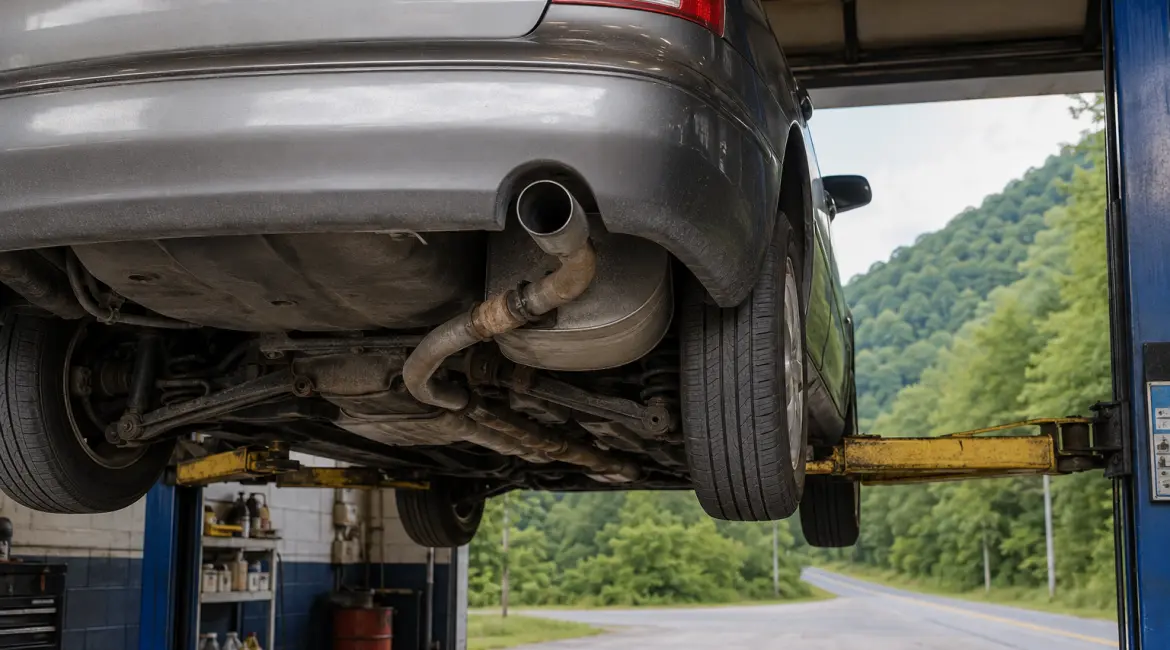
A common exhaust appointment starts with a driver saying, “I think I need a new muffler.” The vehicle became noticeably louder during the morning commute, and the owner is already worried about the cost of replacing the muffler or catalytic converter. Once the vehicle is raised, however, the source may turn out to be a separated flange, broken hanger, or small leak near the flex pipe.
That distinction matters. These problems can sound nearly identical from the driver’s seat, but they require very different repairs. It is why an exhaust diagnosis should begin with an inspection rather than an assumption based on noise alone.
Exhaust problems are especially common on older commuter vehicles traveling Route 29, Amherst Highway, and rural Amherst County roads. Potholes and rough pavement can damage low-mounted components, while humidity, condensation, and years of temperature changes encourage corrosion inside pipes, mufflers, clamps, and welded joints.
Chrome Auto Repair is a family-owned shop serving Madison Heights, Lynchburg, Sweet Briar, and surrounding Central Virginia communities. Established in 2020, the shop brings more than 25 years of automotive experience to each diagnosis. ASE-certified technicians inspect the problem, explain what they find, and provide a clear estimate before repairs begin.
The shop is also BBB Accredited, and qualifying repairs are protected by an O’Reilly-backed 3-Year/36,000-Mile Warranty. Recommendations are based on what the vehicle actually needs. A loose heat shield should not be treated like a failed catalytic converter, and a cracked flange should not automatically lead to replacement of the entire exhaust system.
If your vehicle suddenly sounds louder or you notice an exhaust odor, having it inspected early can prevent a small problem from damaging other components.
How Your Vehicle’s Exhaust System Works and Why Every Component Matters
The exhaust system works much like your home’s chimney. It carries combustion gases away from the passenger compartment while helping the engine operate efficiently. Modern exhaust systems also reduce noise and use emissions-control components to convert harmful pollutants into less harmful gases.
The system begins at the exhaust manifold, where gases leave the engine. From there, oxygen sensors and the catalytic converter help the engine computer manage fuel delivery and monitor emissions. Farther back, the resonator and muffler control sound, while pipes, clamps, flanges, and hangers keep the system sealed and supported beneath the vehicle.
Important exhaust components include:
- The exhaust manifold, which collects gases leaving the engine’s cylinders.
- The manifold gasket, which seals the connection between the engine and manifold.
- The upstream oxygen sensor, which helps the computer monitor the air-fuel ratio.
- The catalytic converter, which processes harmful exhaust pollutants.
- The downstream oxygen sensor, which monitors catalytic converter performance.
- The flex pipe, which absorbs normal engine movement.
- The resonator and muffler, which control exhaust noise.
- The exhaust piping and tailpipe, which carry gases toward the rear of the vehicle.
- The hangers, clamps, and flanges, which support and connect the system.
- The heat shields, which protect the floor and nearby components from exhaust heat.
A problem in one area can affect several others. For example, a leak ahead of the upstream oxygen sensor can introduce outside air into the exhaust stream. The sensor may interpret that added oxygen as a lean air-fuel mixture, even when combustion inside the engine is normal. The computer may then adjust fuel delivery, creating unusual fuel trim readings and reducing fuel economy.
Engine movement also matters. A worn engine mount or excessive vibration can place additional stress on a flex pipe, flange, or welded connection. An exhaust hanger that breaks may allow the piping to sag, contact the vehicle body, and place additional strain on neighboring joints.
Many exhaust problems begin with one small component. Left unrepaired, heat, corrosion, or uncontrolled movement can spread damage through several sections of the system.
7 Warning Signs Your Vehicle May Have an Exhaust Leak
Your Vehicle Suddenly Sounds Louder
A sudden roar, rumble, ticking sound, or sharp exhaust note usually means sound is escaping before it reaches the muffler. The location and character of the noise can provide useful clues.
A ticking noise that is most noticeable during a cold start may come from a manifold gasket, cracked exhaust manifold, or leaking flange. Metal expands as it warms, so the opening may become smaller and the sound may fade after several minutes.
That temporary change is easy to misinterpret. The vehicle may seem to have fixed itself, but the leak is still present. Repeated heating and cooling cycles can allow it to grow.
A deep roar from underneath the vehicle is more likely to involve damaged piping, a failed muffler, or a separated connection. When describing the problem to a technician, mention whether it is loudest during a cold start, acceleration, idle, or highway driving.
You Smell Exhaust Inside the Cabin
An exhaust smell inside the car requires prompt attention. Leaks near the exhaust manifold, flex pipe, floor pan, or rear of the vehicle may allow fumes to enter the passenger compartment. Exhaust can contain carbon monoxide, an odorless gas that cannot be reliably detected by smell alone.
If anyone in the vehicle experiences a headache, dizziness, nausea, confusion, or unusual fatigue, move to fresh air. Avoid continuing to drive if doing so may be unsafe, and arrange for the vehicle to be inspected promptly.
An odor inside the cabin, a pipe hanging beneath the vehicle, or sudden power loss should be treated more urgently than a light rattle from a confirmed loose heat shield. Not every exhaust noise is an emergency, but fumes inside the vehicle should never be dismissed as a routine inconvenience.
Your Check Engine Light Comes On
An exhaust leak can cause a check engine light when it changes oxygen sensor readings or interferes with catalytic efficiency monitoring. Possibilities include a leak ahead of an oxygen sensor, a slow sensor response, an inefficient catalytic converter, or an air-fuel ratio problem unrelated to the exhaust itself.
A trouble code identifies the system that detected an abnormal condition. It does not automatically prove that the component named in the code has failed.
One common mistake is replacing an oxygen sensor simply because its code appears in the scan results. The sensor may be reporting abnormal exhaust conditions correctly. If a leak, misfire, wiring problem, or fuel-control issue caused the reading, installing another sensor will not correct the underlying fault.
Proper check engine light diagnostics may include scan tool data, fuel trim analysis, oxygen sensor monitoring, and inspection for leaks before parts are replaced.
Your Fuel Economy Declines
A leak that alters oxygen sensor readings can cause the engine computer to adjust fuel delivery unnecessarily. An exhaust restriction can also force the engine to work harder.
Not every change in fuel economy comes from the exhaust system. Tire pressure, driving habits, ignition problems, fuel delivery, temperature changes, and extended idling all affect mileage. However, declining fuel economy combined with exhaust noise, odor, sluggish performance, or a warning light deserves investigation.
You Hear Rattling Underneath the Vehicle
A metallic rattle does not always mean the muffler or catalytic converter has failed. Loose heat shields, broken exhaust hangers, damaged clamps, and pipes contacting the body can create surprisingly loud noises.
Heat shield rattles often change with engine speed or occur within a narrow RPM range. A broken hanger may cause clunking over bumps or when the vehicle shifts between drive and reverse.
This is one reason sound alone is not enough to authorize an expensive repair. A technician needs to inspect the mounting points and surrounding components before deciding whether the noise comes from inside a converter or from a loose part touching it.
Your Vehicle Feels Sluggish During Acceleration
A restricted catalytic converter or crushed exhaust pipe can limit the engine’s ability to release exhaust gases. The driver may notice weak acceleration, loss of power at higher speeds, excessive heat, or an engine that struggles under load.
Ignition, fuel delivery, transmission, and airflow problems can create similar symptoms. A technician should not blame the catalytic converter without testing. Scan tool data, exhaust backpressure testing, and comparison of engine behavior under different loads can help distinguish a restriction from other drivability concerns.
Your Vehicle Has a Virginia State Inspection Concern
Certain exhaust defects may contribute to a Virginia State Inspection failure depending on the condition and applicable requirements. Excessive noise, leaking components, insecure piping, or other safety-related defects may require attention.
A check engine light can indicate an emissions or engine-performance problem that should be diagnosed, but state safety inspection and emissions-testing requirements are not identical in every situation. Questions about a specific vehicle should be evaluated by an authorized Virginia inspection station.
What many drivers do not realize is that noise and risk do not always increase together. A large opening near the rear muffler may be extremely loud, while a smaller leak near the exhaust manifold or flex pipe may be quieter but more likely to allow fumes toward the passenger compartment.
Drivers commuting between Madison Heights and Lynchburg often first notice symptoms during highway driving, when engine load and exhaust flow increase. The earlier the problem is diagnosed, the easier it may be to repair before corrosion or movement damages the surrounding components.
What Causes Exhaust Systems to Fail Faster in Madison Heights?
Exhaust systems operate through repeated heating and cooling cycles. Temperatures rise quickly during driving and fall after the vehicle is parked. That expansion and contraction place stress on pipes, welds, flanges, gaskets, and mounting points.
Moisture is another major factor. Water vapor is a normal product of combustion. During short trips, the exhaust system may not remain hot long enough to evaporate the moisture that collects inside it. Condensation can remain in the muffler or piping and encourage corrosion from the inside out.
A vehicle used mainly for short trips around Madison Heights may experience more internal exhaust corrosion than one driven long enough to reach full operating temperature. The system needs sustained heat to evaporate much of the moisture created during combustion.
Central Virginia does not expose vehicles to the same amount of winter road salt found in some northern states, but corrosion is still common. Seasonal humidity, condensation, Virginia temperature changes, and years of heat cycling gradually weaken pipes and welded seams. Vehicles that regularly travel rough Amherst County roads may also experience mounting damage that adds movement and speeds up the process.
Other contributing conditions include:
- Pothole impacts that dent or shift low-mounted exhaust components.
- Broken hangers that allow the system to move excessively.
- Loose clamps and deteriorated flange connections.
- Engine vibration that strains flex pipes and welds.
- Stop-and-go travel that creates frequent temperature cycles.
- High-mileage operation that weakens original mounting points.
- Contact between exhaust piping and the vehicle body.
Flex pipes face a different type of wear. Their braided and corrugated construction allows them to absorb engine movement, but excessive vibration, corrosion, or worn engine mounts can cause the material to separate.
Exhaust manifolds may crack after years of thermal stress. Manifold gaskets can deteriorate, fasteners may loosen or corrode, and flange surfaces can become uneven. Once an opening develops, hot gases may erode the surrounding material and enlarge the leak.
One of the most common problems technicians encounter is not a failed muffler at all. It is a damaged hanger or loose heat shield producing a similar noise. That is why a lift inspection should come before a repair recommendation.
Is It a Muffler Problem, an Exhaust Leak, or Something Else?
Different exhaust faults can produce similar symptoms. This guide can help narrow the possibilities, but it cannot replace hands-on testing.
| Symptom | Possible Cause |
|---|---|
| Loud roaring noise | Damaged muffler, separated pipe, or broken connection |
| Ticking during a cold start | Exhaust manifold, gasket, or flange leak |
| Rotten egg odor | Catalytic converter or engine-performance problem |
| Hissing sound | Small exhaust leak or cracked piping |
| Rattling underneath | Loose heat shield, hanger, clamp, or internal component |
| Check engine light | Oxygen sensor, exhaust leak, catalyst, or air-fuel concern |
| Poor fuel economy | Incorrect sensor readings, exhaust leak, or restriction |
| Weak acceleration | Restricted converter or damaged piping |
| Clunking over bumps | Broken hanger or exhaust contacting the body |
The odor sometimes described as rotten eggs may involve sulfur compounds in the exhaust. That does not automatically mean the catalytic converter needs replacement. An overly rich air-fuel mixture, misfire, or fuel-control problem can overload and overheat the converter. Replacing it without correcting the underlying engine problem may damage the new unit.
Likewise, familiar vehicles such as a Toyota Camry, Honda Accord, Nissan Altima, Chevrolet Equinox, Honda CR-V, Subaru Outback, or Jeep Grand Cherokee can develop exhaust noise as they age. Trucks such as a 2014–2020 Ford F-150 or 2013–2019 Chevrolet Silverado have long exhaust assemblies with multiple joints and supports.
The correct diagnosis depends on where the sound originates, when it occurs, and what the surrounding components look like. The make or model alone does not determine which part should be replaced.
Why Ignoring a Small Exhaust Leak Can Become a Much Bigger Repair
It is understandable to postpone a repair when the vehicle still starts, accelerates, and reaches its destination. Drivers often think, “It still drives fine, so I have time.” Unfortunately, a small exhaust problem can continue to damage surrounding components even when the vehicle feels normal.
A leak may become more expensive because it can:
- Enlarge as hot gases erode the opening.
- Place additional stress on nearby pipes and welded joints.
- Affect oxygen sensor readings and fuel delivery.
- Reduce fuel economy.
- Contribute to catalytic converter overheating.
- Allow fumes to reach the passenger compartment.
- Create excessive noise.
- Lead to inspection concerns.
- Increase long-term ownership costs.
Catalytic converters are designed to process gases from normal combustion. Misfires, excessive fuel delivery, oil consumption, coolant entering the cylinders, or long-term fuel-control problems can raise converter temperature and damage its internal substrate. A converter that melts or breaks apart may create an exhaust restriction that reduces engine performance.
Carbon monoxide exposure is the most important immediate concern. A suspected leak near the cabin should not be treated like a routine noise complaint, especially if fumes are noticeable or occupants feel ill.
Addressing a small exhaust issue early can help prevent it from becoming a larger repair.
Repair or Replace? How We Determine the Best Solution
Not every exhaust problem requires complete replacement. The right repair depends on the failed component, the surrounding metal, the vehicle’s design, and the overall condition of the system.
Welding may be appropriate when the metal around the damaged area is structurally sound and a durable repair can be completed safely. Welding thin, heavily corroded material usually provides poor long-term results because the surrounding metal may continue to break apart.
Sectional replacement can be a cost-effective solution when damage is limited to one pipe, flex section, muffler, resonator, or flange. A muffler may also be replaced independently when the connecting pipes remain serviceable.
In our view, a catalytic converter should not be condemned based on a single efficiency code alone. Oxygen sensor activity, exhaust leaks, misfire history, fuel-control data, converter temperature, and exhaust backpressure can all provide important context.
Catalytic converter replacement is appropriate when testing confirms that the converter is inefficient, physically damaged, contaminated, or restricted. Technicians should also determine why it failed. An unresolved misfire, fuel-delivery problem, oil consumption issue, or coolant leak could damage the replacement.
Complete exhaust system replacement may make sense when corrosion affects multiple sections, safe mounting points are gone, or individual repairs would cost nearly as much while leaving other weakened components in place.
Chrome Auto Repair recommends the option that addresses the actual failure and considers the condition of the rest of the system. Customers receive an explanation and transparent estimate, and repairs begin only after approval.
Common Exhaust Problems That Can Produce Misleading Symptoms
The following are common examples of why experienced technicians avoid recommending exhaust parts based on sound alone.
A Suspected Muffler Failure May Be a Cracked Flange
A vehicle arrives with a loud exhaust, and the owner expects to buy a muffler. During the lift inspection, the muffler is intact. The noise is coming from a cracked flange farther forward in the system.
Repairing the failed connection may address the sound without replacing a serviceable muffler. The same general noise could also come from a damaged flex pipe or separated welded joint, which is why the location of the leak matters more than the volume alone.
A Manifold Leak Can Affect Oxygen Sensor Readings
A driver may worry that a check engine light means the catalytic converter has failed. Scan data shows unusual oxygen sensor activity and fuel trim readings, but that information does not yet prove the converter is defective.
A cold-start inspection may reveal a small exhaust manifold or gasket leak allowing outside air into the exhaust stream. Repairing the leak restores the integrity of the system and allows the sensors to report more accurate information.
A Loud Rattle Can Come From a Heat Shield
A metallic rattle may sound serious because it becomes loud within a particular engine-speed range. The exhaust piping and converter may be secure, while a corroded attachment point allows a heat shield to vibrate.
Securing or repairing the shield can eliminate the noise without unnecessary exhaust replacement. A technician still needs to inspect the surrounding metal because a shield may loosen when corrosion affects its mounting point.
An Unnoticed Leak Can Contribute to Poor Fuel Economy
Not every exhaust leak announces itself with a dramatic roar. A driver may notice a gradual decline in mileage or a check engine light before hearing a clear noise.
When a leak develops near an oxygen sensor, the resulting airflow can affect sensor feedback and fuel control. After the leak is repaired, the technician can verify sensor operation and determine whether any additional engine-performance problem remains.
These situations are not rare or unusual. They illustrate why exhaust leak detection matters and why similar symptoms can require very different repairs.
How Chrome Auto Repair Approaches Exhaust Diagnosis
The inspection starts with the symptom, not a predetermined parts list. If the complaint is a cold-start tick, the technician may need to hear the vehicle before it warms up. If the problem is weak acceleration, the process may include scan data and exhaust backpressure testing. A visible opening in a muffler generally does not require the same diagnostic process as an intermittent catalyst-efficiency code.
The technician first asks when the condition occurs:
- Is the noise louder during a cold start?
- Does it change during acceleration?
- Is there an odor inside or outside the vehicle?
- Does the vehicle rattle over bumps?
- Has fuel economy changed?
- Is the check engine light steady or flashing?
- Does the engine lose power at highway speeds?
After the vehicle is raised, the technician examines the exhaust manifold, flanges, flex section, pipes, clamps, muffler, resonator, catalytic converter, hangers, heat shields, and welded joints. Soot marks may reveal where gases are escaping, while polished contact points can show where the system is striking the vehicle body.
Some leaks are obvious as soon as the vehicle is raised. Others appear only during a cold start, under engine load, or when an exhaust joint moves. That is why diagnosis may require more than looking for a visible hole in the muffler.
When the source is not obvious, testing may include:
- Smoke testing to reveal small openings that are difficult to hear or see.
- Scan tool diagnostics to review trouble codes and operating data.
- Fuel trim analysis to determine how the computer is adjusting fuel delivery.
- Oxygen sensor monitoring to compare upstream and downstream activity.
- Exhaust backpressure testing when a restriction is suspected.
- Road testing to reproduce noises or performance problems under load.
Oxygen sensor information requires careful interpretation. The upstream sensor is used primarily for fuel control, while the downstream sensor helps monitor catalytic efficiency. A leak, wiring issue, sensor fault, engine misfire, or failing converter may alter these signals in different ways.
Once the source is confirmed, Chrome Auto Repair explains the findings and provides an estimate. After the customer approves the work, the repair is completed and verified through visual inspection, scan data, a road test, or another method appropriate for the original complaint. A final quality check confirms that the system is secure and the reported symptom has been addressed.
Can an Exhaust Leak Cause a Virginia State Inspection Failure?
Yes, certain exhaust problems may contribute to a Virginia State Inspection failure, depending on the defect, vehicle, and applicable requirements.
Potential concerns include leaking components, insecure piping, excessive exhaust noise, damaged mounting hardware, and conditions that create a safety hazard. A check engine light may also indicate an emissions or engine-performance problem that deserves diagnosis, although requirements can vary by inspection type and location.
Preparing early is usually easier than discovering a problem when an inspection deadline is approaching. If you hear a new noise, notice fumes, or see piping hanging lower than normal, schedule an evaluation before the issue worsens.
Before an inspection appointment, note when the noise occurs and whether it changes during cold starts, acceleration, highway driving, or travel over bumps. That information can help the technician reproduce the concern.
Do not crawl beneath a vehicle supported only by a jack, and do not touch exhaust components that may still be hot. Questions about whether a specific condition meets Virginia requirements should be evaluated by an authorized Virginia inspection station.
Why Madison Heights Drivers Choose Chrome Auto Repair for Exhaust Repairs
Good exhaust repair begins with knowing when a component can be repaired and when replacement is the safer long-term choice. Chrome Auto Repair’s ASE-certified technicians draw on more than 25 years of experience to make that distinction and explain it clearly to the vehicle owner.
The family-owned, BBB Accredited shop provides transparent estimates and obtains approval before beginning repairs. Qualifying work is covered by an O’Reilly-backed 3-Year/36,000-Mile Warranty.
Rather than assuming every loud vehicle needs a complete exhaust system, the technicians inspect the entire assembly. That process can distinguish a failed muffler from a cracked flange, loose heat shield, damaged flex pipe, worn hanger, sensor issue, or engine-performance problem.
Customers can enjoy free coffee while waiting, and a complimentary shuttle through Uber may be available when transportation is needed. The shop’s location on South Amherst Highway serves drivers from Madison Heights, Lynchburg, Sweet Briar, and surrounding Amherst County communities.
Frequently Asked Questions About Exhaust Repair
Can I drive with an exhaust leak?
Driving with an exhaust leak is not recommended until you know its location and severity. A small opening near the rear muffler presents different concerns from a manifold or flex-pipe leak that may allow gases near the cabin.
If you smell fumes inside, hear a sudden loud noise, see hanging components, or experience headache, dizziness, nausea, confusion, or unusual fatigue, move to fresh air and avoid continued driving if it may be unsafe. Arrange for an inspection promptly.
What does an exhaust leak sound like?
An exhaust leak may sound like ticking, hissing, tapping, roaring, or rumbling. A manifold or gasket leak often produces a ticking sound during a cold start, while a damaged pipe or muffler may create a deeper roar that becomes louder during acceleration.
Loose heat shields and hangers can rattle or clunk instead. Pay attention to when the sound occurs because that detail can help a technician locate the source.
Can an exhaust leak cause my check engine light to come on?
Yes. A leak can trigger the check engine light if it changes oxygen sensor readings or affects catalytic converter monitoring.
A leak ahead of a sensor may draw outside air into the exhaust stream and create misleading data. The light could also involve a sensor, wiring fault, misfire, fuel-control issue, or inefficient converter. Testing should be completed before replacing a part based only on a trouble code.
Will an exhaust leak affect fuel economy?
It can. A leak may interfere with oxygen sensor feedback and cause the engine computer to adjust fuel delivery unnecessarily. A restricted converter can also reduce efficiency by increasing exhaust backpressure.
Fuel mileage is affected by many factors, including tire pressure, driving habits, weather, ignition performance, and fuel delivery. The complete vehicle should be evaluated before assuming the exhaust system is solely responsible.
Can an exhaust leak cause a Virginia inspection failure?
Certain exhaust leaks or related defects may contribute to a Virginia State Inspection failure. Leaking components, excessive noise, damaged hangers, insecure piping, or another safety concern may require correction.
Requirements depend on the vehicle, defect, and applicable inspection rules. An authorized Virginia inspection station can determine how a specific condition applies to your vehicle.
How long does exhaust repair usually take?
Repair time depends on the failed component, corrosion, parts availability, and accessibility. Securing a loose heat shield or replacing a hanger may be straightforward. A rusted manifold, seized fasteners, damaged catalytic converter, or custom pipe section can require substantially more time.
An inspection allows the shop to identify the exact failure and provide a realistic schedule before work begins.
How much does exhaust repair cost?
The cost depends on what failed and whether repair or replacement is appropriate. Important factors include vehicle design, labor accessibility, corrosion severity, parts quality, damaged hardware, and the condition of adjacent components.
Corroded fasteners often determine whether a repair remains straightforward. A flange gasket may be inexpensive, but seized or broken hardware can increase the labor needed to separate and reseal the connection safely. A hands-on inspection is the most reliable way to determine the appropriate repair and prepare an accurate estimate.
Need Exhaust Repair in Madison Heights, VA?
If you hear a ticking, rattling, roaring, or hissing sound, smell exhaust inside the vehicle, or have a check engine light that may involve the emissions system, Chrome Auto Repair can inspect the vehicle and explain the findings.
Chrome Auto Repair
4998 S Amherst Hwy, Madison Heights, VA 24572
Follow Chrome Auto Repair on Facebook, check out recent shop updates on Instagram, or connect with the shop on X.
With experienced technicians, honest diagnostics, clear explanations, and warranty-backed repairs, Chrome Auto Repair helps Central Virginia drivers make informed decisions without unnecessary pressure.